

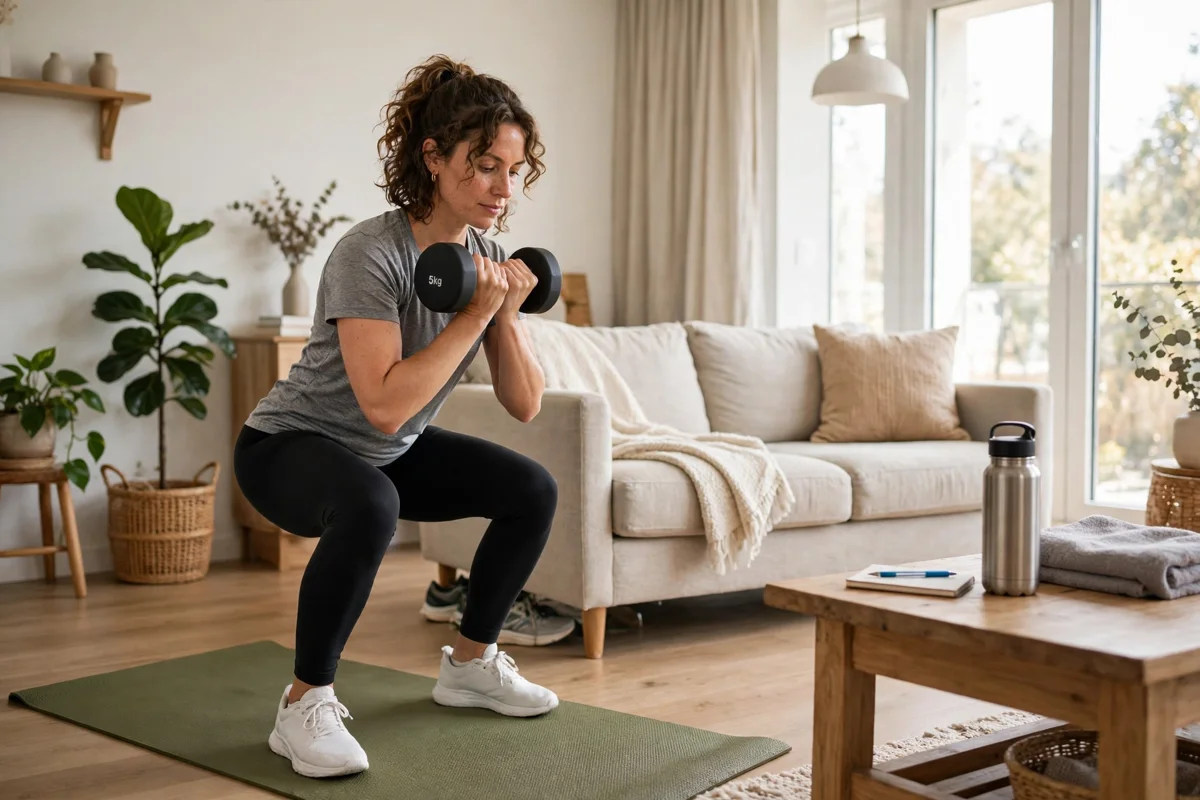
Starting strength training at home for beginners is simpler than most people expect. You do not need a gym membership, a rack of machines, or hours of spare time — you need a small clear floor space, a handful of basic movements done well, and a routine you can repeat. This guide walks through the equipment that actually matters, the five exercises that form the foundation of almost every programme, and how to structure your week so that training becomes a habit rather than a short-lived resolution.
Why Strength Training at Home Works
Muscle responds to progressive resistance, not to postcode. Bodyweight movements and a modest pair of dumbbells can challenge every major muscle group, and training at home removes the two biggest barriers to consistency: travel time and cost. There is also a privacy advantage for beginners, who can learn technique at their own pace without an audience. Beyond appearance, regular strength work supports bone density, joint health, posture and everyday tasks such as carrying shopping, climbing stairs and playing with children or grandchildren. Two or three short sessions a week are enough to see measurable progress in the first few months.
The Only Equipment You Really Need
Start with nothing but your bodyweight, then add equipment gradually. A non-slip exercise mat makes floor work comfortable. A pair of adjustable dumbbells, or two fixed pairs in different weights, covers most upper and lower body exercises. A sturdy chair or low step is useful for supported rows, step-ups and triceps dips, and a resistance band adds variety for a few pounds. Kettlebells are a worthwhile later addition for swings and carries. Avoid buying large machines until you have trained consistently for several months — most beginners who quit do so because of routine problems, not equipment problems.
Five Foundational Exercises to Learn First
The squat trains your legs and glutes. Stand with feet about shoulder-width apart, sit your hips back and down as if into a chair, keep your chest lifted, and drive through your heels to stand. The push-up builds the chest, shoulders and triceps: keep your body in one straight line from head to heels, lower with control, and elevate your hands on a step or counter if a full push-up is too hard at first. The hip hinge, practised with dumbbells as a deadlift, strengthens the back of the body — push your hips backwards with a flat back rather than bending from the waist. The row, done bent-over with dumbbells or with one hand supported on a chair, balances the push-up by training your back and biceps. Finally, the plank teaches core stability: brace as if about to be poked in the stomach and hold a straight line without letting your hips sag. Spend your first two weeks practising these movements slowly with light or no weight; good technique now prevents injuries later.
A Simple Three-Day Weekly Structure
Beginners progress best on full-body sessions repeated three times a week with a rest day between each — for example Monday, Wednesday and Friday. Each session, pick one exercise for the legs (squat or lunge), one push (push-up or overhead press), one pull (row), one hinge (deadlift) and one core movement (plank). Perform two or three sets of eight to twelve controlled repetitions, resting a minute or two between sets, and finish while you still feel you could do slightly more. When the top of the rep range feels easy on every set, increase the weight a little or slow the movement down. Write down what you did; a simple notebook makes progress visible and is the home trainer’s equivalent of a coach.
Warming Up, Cooling Down and Staying Safe
Begin each session with five minutes of easy movement — marching on the spot, arm circles, bodyweight squats and a few gentle lunges — to raise your temperature and loosen your joints. Your first set of each exercise should use a lighter weight as a rehearsal. Afterwards, a few minutes of relaxed stretching for the muscles you trained helps you leave the session feeling loose rather than stiff. Sharp pain is a stop signal, not something to push through; ordinary effort and next-day muscle soreness are normal, joint pain is not. If you have a medical condition, are returning after injury, or are pregnant, check with your doctor or a physiotherapist before starting.
Staying Consistent When Motivation Dips
Every beginner has weeks where training feels like a chore. The fix is rarely more motivation — it is a smaller, clearer commitment: lay your kit out the night before, attach the session to an existing habit such as straight after breakfast, and never miss twice in a row. The same principles that help students build a routine that sticks, which we cover in our guide on how to build a study routine, apply directly to exercise: fixed times, a prepared environment and visible tracking beat willpower every time. Treat the first month as practice, not performance.
Training on a Budget and Away From Home
One of the strengths of a home programme is that it travels with you. Bodyweight circuits work in a hotel room or a holiday rental, and a resistance band weighs almost nothing in a suitcase. If you plan trips around being outdoors, our budget travel tips will help you keep costs down, and destinations with good walking and swimming — such as those in our guides to places to visit in Maine during the summer and places to visit in the USA for summer — make it easy to stay active without a formal workout. At home, remember that effective equipment can be bought second-hand for a fraction of the new price.
Getting the Whole Family Moving
Children learn attitudes to exercise by watching adults, and short, playful sessions beat formal training for younger family members. If you are looking for ideas, our article on sports for non-athletic kids shows how confidence grows when the emphasis is on fun rather than competition. Let children join in with their own light movements, keep sessions short, and celebrate effort rather than results.
How Soon Will You See Results?
Most beginners feel stronger within three to four weeks — movements that once needed full effort begin to feel controlled, and everyday lifting gets easier. Visible changes take longer, usually eight to twelve weeks of consistent training paired with enough protein and sleep. Progress is rarely linear: expect the odd plateau, adjust the difficulty, and keep going. The routine only has to work on average, not perfectly, for the results to arrive.
Strength training at home rewards patience. Learn the five foundations, train three times a week, add a little difficulty as movements become easy, and give the habit a full month to settle. Within a few weeks most beginners notice firmer muscles, better posture and more energy through the day — proof that an effective programme does not need a gym, only a plan you can repeat.


